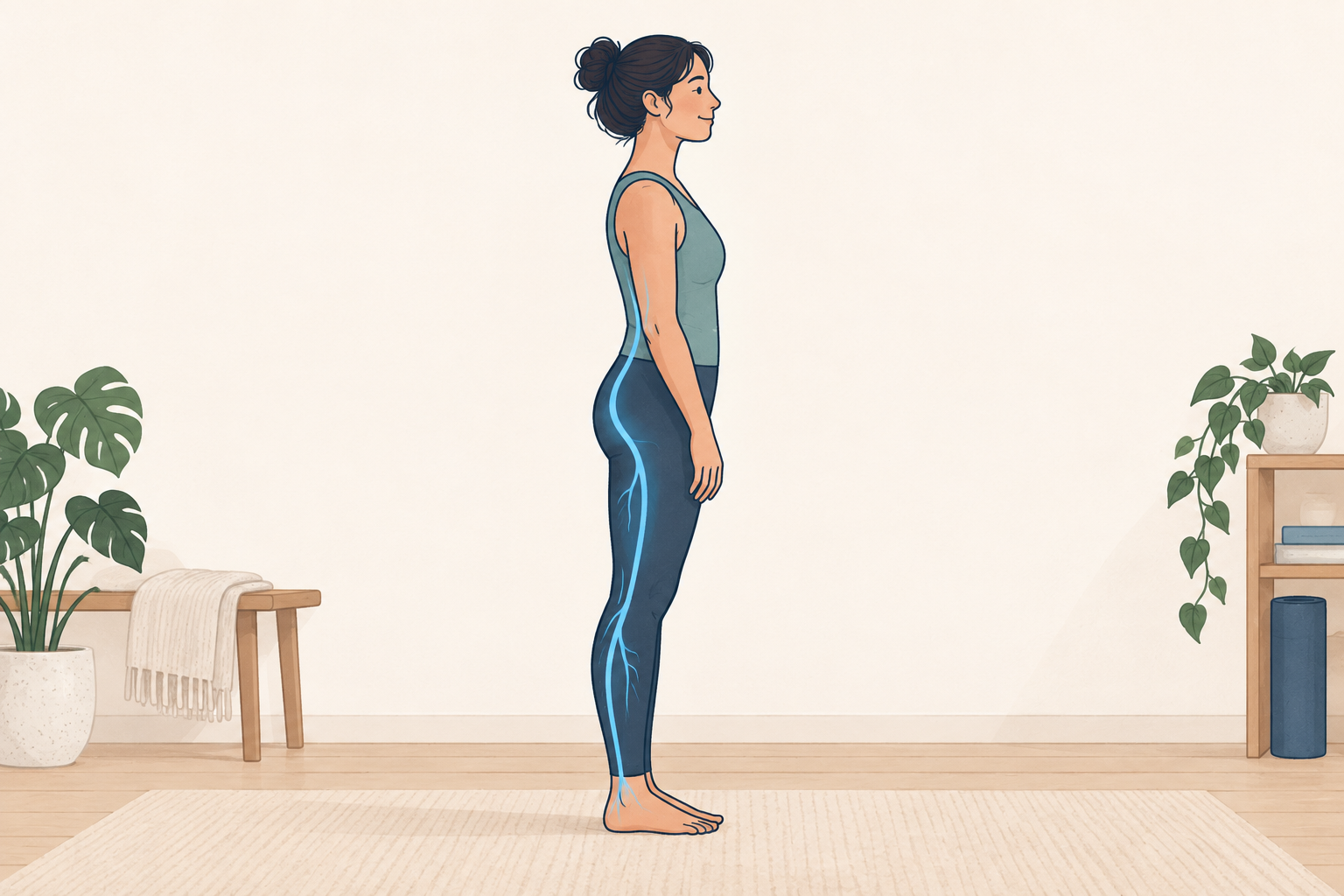
What's going on
PhysioOnClick assesses and manages sciatica by video, or with a home visit in the Glasgow area, and the guidance below reflects exactly what that assessment covers. Sciatica describes nerve root irritation, most commonly from a disc bulge pressing on or chemically irritating a nerve root as it exits the spine, producing pain, pins and needles or numbness that can travel down the leg past the knee. This is different from general low back pain because the nerve itself — not just the joint or muscle — is involved, which changes both the expected timeline and the assessment.
The reassuring evidence is that most disc-related sciatica improves within weeks to a few months without surgery, as the disc irritation and any inflammatory swelling settle. NICE guidance on managing sciatica supports a staged approach: staying appropriately active, targeted exercise and pain management, with imaging and surgical opinion reserved for cases that fail to improve or show worsening neurological signs.
Practical guidance on walking tolerance
Walking tolerance — how far or long someone can walk before symptoms force a stop — is one of the most useful, easy-to-track measures of overall progress across almost every physiotherapy condition, because it reflects strength, pain, confidence and cardiovascular fitness together in one simple number.
Building walking tolerance works best as a gradual, time-based progression (adding a few minutes every few days) rather than pushing to a fixed distance regardless of symptoms, and pairing it with planned rest points if a route allows, rather than stopping only once symptoms have already become significant.
Assessment and when to get extra help
Assessment includes straight leg raise and neural tension testing, checking reflexes, muscle power and sensation in specific nerve root distributions down the leg, and screening for the alternative pattern of spinal stenosis, where symptoms are usually worse standing and walking and ease with sitting or leaning forward.
Any new saddle numbness (around your genitals or bottom), difficulty starting or controlling peeing or controlling your bowels, rapidly progressive leg weakness, or sciatica in both legs are cauda equina red flags: call 999 or go to A&E, and do not drive yourself - this is one of the few genuine physiotherapy emergencies.
A practical starting point
Time a comfortable walk this week without pushing through symptoms, then aim to add two to three minutes to that baseline every few days, keeping a simple log so progress (or a plateau worth addressing) is easy to see.
This guide is part of PhysioOnClick's patient education library and is intended to support informed decisions, not replace an individual assessment. If symptoms are worsening, unclear, or affecting your confidence with movement, a full physiotherapy assessment is the safest next step.
Is standing good for sciatica?
It depends on the underlying cause rather than being universally good or bad. For typical disc-related sciatica, alternating between sitting, standing and walking — avoiding any single position for very long stretches — tends to work better than either prolonged standing or prolonged sitting. If standing consistently eases symptoms while sitting or bending forward worsens them, that pattern is actually useful diagnostic information for a physiotherapy assessment.
The exception is spinal stenosis, where the opposite pattern is common: standing and walking often worsen symptoms, while sitting or leaning forward (which opens up the space around the nerve) tends to ease them. This is one of the clearest ways a physiotherapist distinguishes disc-related sciatica from a stenosis-driven presentation, and it changes which advice actually helps.
Does elevating your legs help sciatica?
For some people, yes, temporarily — lying with the knees bent and lower legs supported (on a chair seat or a pile of cushions) reduces tension through the lower back and can ease nerve irritation enough to be genuinely comfortable, particularly during a painful flare-up. It works best as a short-term comfort measure rather than something to rely on for hours at a time, since prolonged inactivity in any single position, including this one, tends to increase stiffness once you do move.
If leg elevation reliably eases symptoms, that's useful information to share with a physiotherapist — positions that consistently help or worsen symptoms say something real about what's driving them, and that pattern helps shape a more targeted rehabilitation plan rather than generic advice.