What's going on
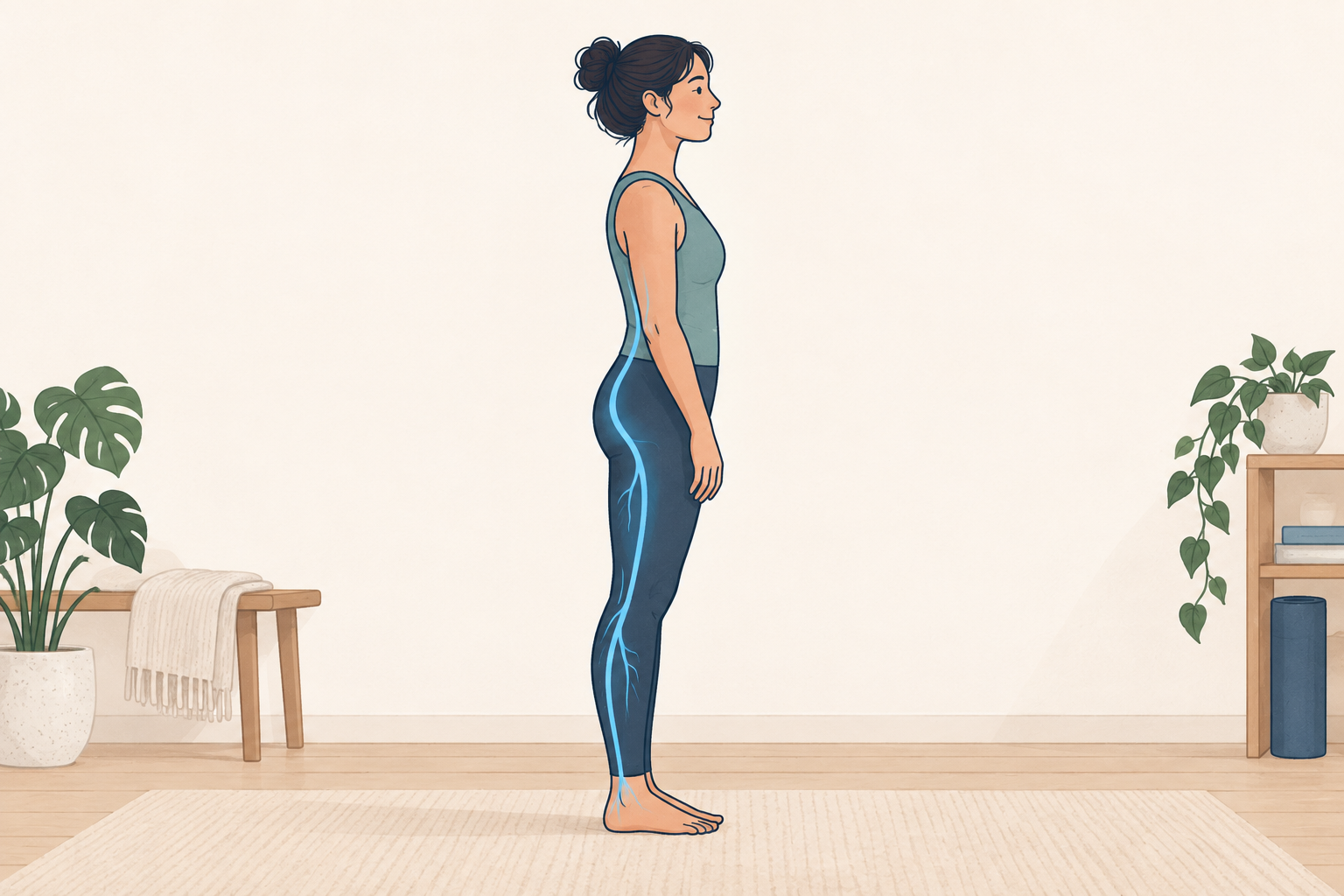
PhysioOnClick assesses and manages sciatica by video, or with a home visit in the Glasgow area, and the guidance below reflects exactly what that assessment covers. Sciatica describes nerve root irritation, most commonly from a disc bulge pressing on or chemically irritating a nerve root as it exits the spine, producing pain, pins and needles or numbness that can travel down the leg past the knee. This is different from general low back pain because the nerve itself — not just the joint or muscle — is involved, which changes both the expected timeline and the assessment.
The reassuring evidence is that most disc-related sciatica improves within weeks to a few months without surgery, as the disc irritation and any inflammatory swelling settle. NICE guidance on managing sciatica supports a staged approach: staying appropriately active, targeted exercise and pain management, with imaging and surgical opinion reserved for cases that fail to improve or show worsening neurological signs.
What physiotherapy assessment looks at
Assessment includes straight leg raise and neural tension testing, checking reflexes, muscle power and sensation in specific nerve root distributions down the leg, and screening for the alternative pattern of spinal stenosis, where symptoms are usually worse standing and walking and ease with sitting or leaning forward.
Where nerve-related symptoms is the main day-to-day problem, assessment also looks specifically at how that symptom behaves — what makes it better or worse, and how it's changed since it started — since that shapes which part of the rehab plan gets priority first.
Practical guidance on nerve-related symptoms
Nerve-related symptoms — pins and needles, numbness, or a burning, electric quality to pain — behave differently from muscular or joint pain and often need a different treatment emphasis, including neural mobility work and addressing any structural compression alongside general strengthening.
It's useful to distinguish symptoms that stay in one area from ones that follow a clear line down a limb in a pattern matching a specific nerve's distribution; the second pattern points more strongly toward true nerve root or peripheral nerve involvement and usually needs more specific assessment before exercise progression.
When to seek extra help
Any new saddle numbness (around your genitals or bottom), difficulty starting or controlling peeing or controlling your bowels, rapidly progressive leg weakness, or sciatica in both legs are cauda equina red flags: call 999 or go to A&E, and do not drive yourself - this is one of the few genuine physiotherapy emergencies.
A practical starting point
Note exactly where symptoms travel (a body outline diagram helps), what specific positions or movements bring them on or ease them, and bring this record to your physiotherapy assessment — it meaningfully speeds up identifying which nerve and level are involved.
This guide is part of PhysioOnClick's patient education library and is intended to support informed decisions, not replace an individual assessment. If symptoms are worsening, unclear, or affecting your confidence with movement, a full physiotherapy assessment is the safest next step.
What causes sciatica?
Sciatica isn't a diagnosis in itself — it's a pattern of symptoms caused by irritation or compression of the sciatic nerve or one of the nerve roots that forms it, most commonly from a disc bulge or herniation pressing on a nerve root as it exits the spine. Less commonly, spinal stenosis (narrowing of the space around the nerves, usually with age-related change) or, rarely, a muscle in the buttock (piriformis) irritating the nerve can produce a similar pattern.
What these causes share is that the nerve itself is being irritated or compressed, not just a joint or muscle — which is why symptoms travel down the leg, sometimes past the knee, rather than staying localised to the back. UK guidance, including NICE, is reassuring on outlook: most disc-related sciatica settles within weeks to a few months as the disc irritation and any associated inflammation reduce, with surgery reserved for cases that don't improve or that show worsening nerve function.