What's going on
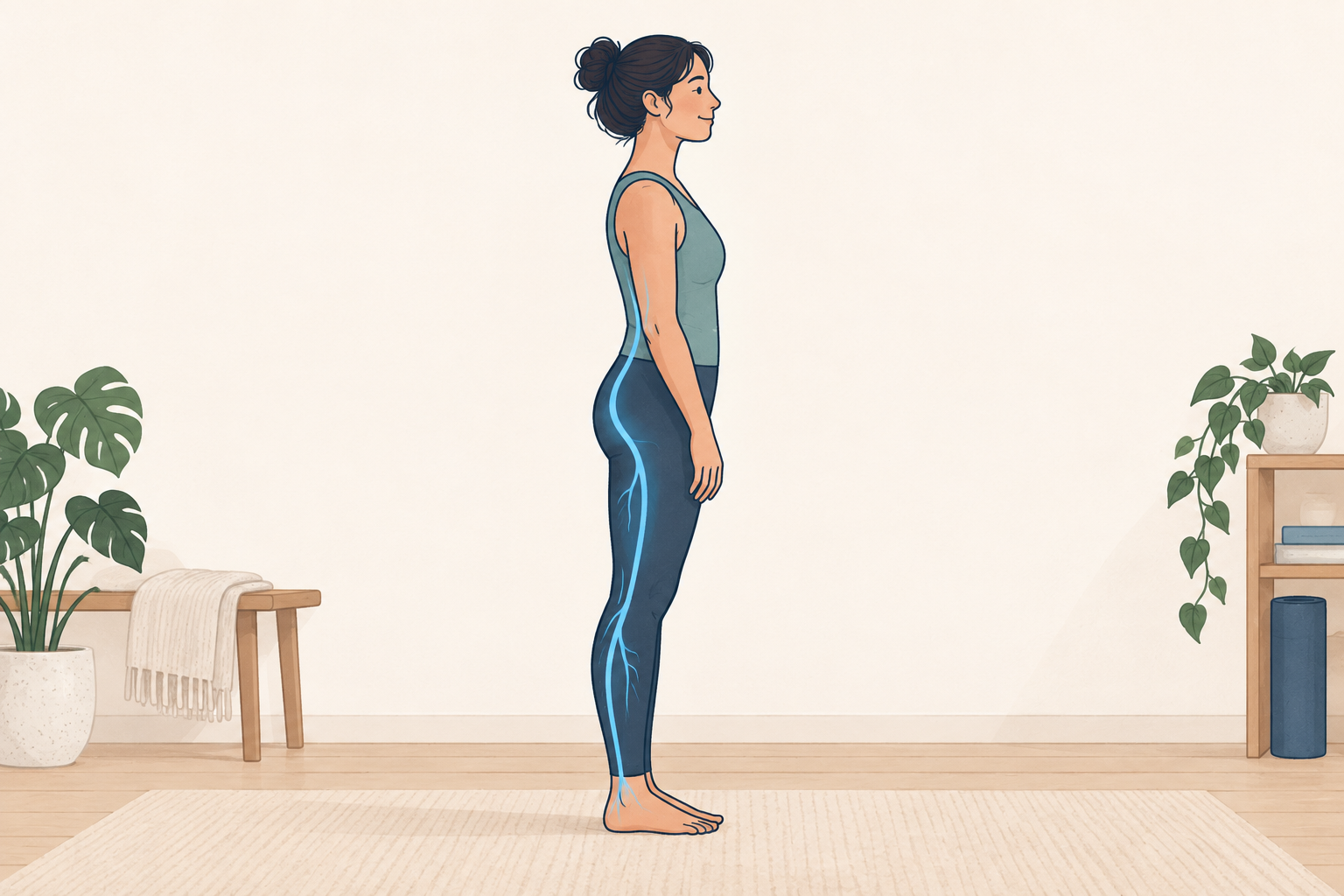
PhysioOnClick assesses and manages sciatica by video, or with a home visit in the Glasgow area, and the guidance below reflects exactly what that assessment covers. Sciatica describes nerve root irritation, most commonly from a disc bulge pressing on or chemically irritating a nerve root as it exits the spine, producing pain, pins and needles or numbness that can travel down the leg past the knee. This is different from general low back pain because the nerve itself — not just the joint or muscle — is involved, which changes both the expected timeline and the assessment.
The reassuring evidence is that most disc-related sciatica improves within weeks to a few months without surgery, as the disc irritation and any inflammatory swelling settle. NICE guidance on managing sciatica supports a staged approach: staying appropriately active, targeted exercise and pain management, with imaging and surgical opinion reserved for cases that fail to improve or show worsening neurological signs.
Practical guidance on morning stiffness
Morning stiffness that eases within thirty to sixty minutes of moving around is typical of mechanical joint and muscle irritation and usually responds well to a short, consistent wake-up routine — a few minutes of gentle range-of-movement work before getting out of bed, followed by a short walk, tends to shorten the stiff period more reliably than stretching alone.
Stiffness that takes several hours to ease, is accompanied by swelling in multiple joints, or is worse on rest days than active ones is a different pattern and worth flagging to a GP alongside physiotherapy, since it can suggest an inflammatory rather than purely mechanical cause.
What physiotherapy assessment looks at
Assessment includes straight leg raise and neural tension testing, checking reflexes, muscle power and sensation in specific nerve root distributions down the leg, and screening for the alternative pattern of spinal stenosis, where symptoms are usually worse standing and walking and ease with sitting or leaning forward.
Where morning stiffness is the main day-to-day problem, assessment also looks specifically at how that symptom behaves — what makes it better or worse, and how it's changed since it started — since that shapes which part of the rehab plan gets priority first.
A practical starting point
Try five minutes of gentle movement — knee-to-chest, cat-cow through the spine, or shoulder circles depending on the affected area — before you're fully upright, then track how long stiffness lasts each morning for two weeks to see if the pattern is improving.
This guide is part of PhysioOnClick's patient education library and is intended to support informed decisions, not replace an individual assessment. If symptoms are worsening, unclear, or affecting your confidence with movement, a full physiotherapy assessment is the safest next step.
When to seek extra help
Any new saddle numbness (around your genitals or bottom), difficulty starting or controlling peeing or controlling your bowels, rapidly progressive leg weakness, or sciatica in both legs are cauda equina red flags: call 999 or go to A&E, and do not drive yourself - this is one of the few genuine physiotherapy emergencies.
Is sciatica worse in the morning?
For many people, yes — spinal discs absorb fluid overnight while lying down and are at their most swollen first thing in the morning, which can transiently increase pressure on a nearby irritated nerve root before the disc redistributes load again through normal daytime movement and loading. That's a different mechanism from general morning back stiffness, which is driven more by muscle guarding and reduced tissue fluid movement than by disc fluid changes specifically.
If mornings are consistently the worst part of the day, that pattern itself is useful information for a physiotherapy assessment — it helps distinguish disc-related nerve irritation from other causes of leg pain that don't follow the same daily rhythm.