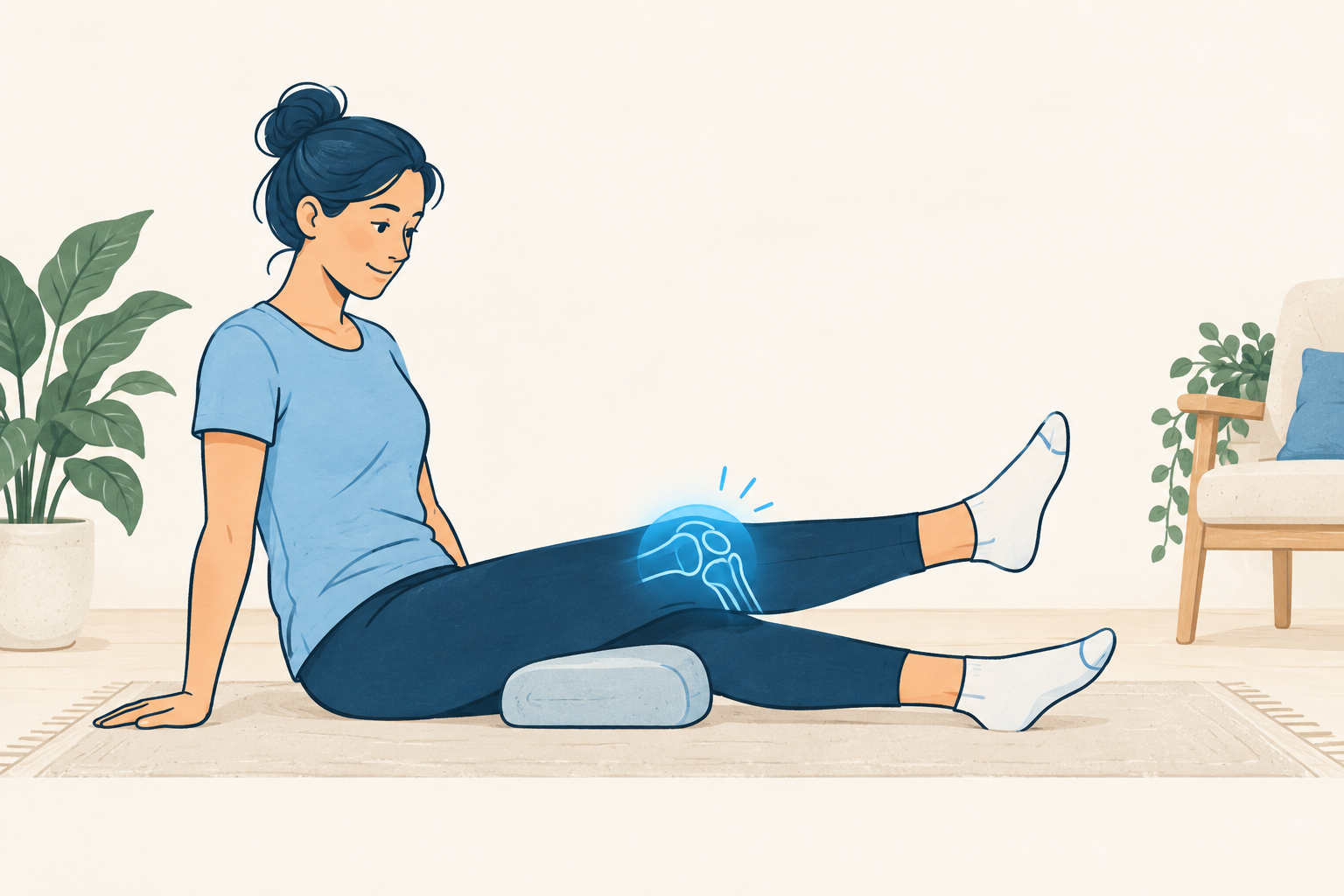
What's going on
Knee assessments at PhysioOnClick happen by video, or as a home visit in the Glasgow area, and the reasoning below is exactly what a physiotherapist looks for in either setting. Knee symptoms usually trace back to one of three patterns: a specific traumatic injury (ligament, meniscus or patellar), an overuse presentation from a sudden change in load (runner's knee, patellar tendinopathy), or degenerative change where cartilage and joint surfaces have gradually lost tolerance to load. Each responds to a different rehab emphasis, which is why a generic 'knee exercise' plan often underperforms.
Swelling, locking, giving way and a clear mechanism of injury point toward a structural cause worth imaging; a gradual ache that builds with specific activities and settles with rest points more toward a load-tolerance problem that usually responds to a structured strengthening programme rather than scans.
Practical guidance on hip and knee strength
Hip strength — particularly the muscles that control the pelvis from side to side and rotation of the thigh — has a disproportionate influence on knee symptoms, because weakness here often shows up as poor control at the knee during single-leg tasks like stairs, running or landing from a jump, even when the knee itself has no structural problem.
A hip-and-knee strengthening programme typically progresses from double-leg to single-leg exercises, and from controlled, slow movements to more dynamic ones (step-downs, single-leg squats, eventually hopping where relevant), matching the demands of whatever activity someone is trying to return to.
Assessment and when to get extra help
Assessment looks at how the knee was injured (or whether it built up gradually), joint line tenderness, ligament stability tests, quadriceps and hip strength, and functional tasks like a single-leg squat or step-down to see how the whole limb shares load, not just the joint itself.
A knee that is hot, red and swollen with a fever needs A&E now, or a call to NHS 111 straight away if you are not sure where to go, to rule out a joint infection. A knee that is significantly swollen within hours of injury, locked in a fixed position, or unable to bear any weight at all needs same-day medical assessment (NHS 111 or an urgent treatment centre) to rule out a fracture or complete ligament rupture before starting rehabilitation.
A practical starting point
Add a simple single-leg exercise — a slow step-down onto a low step, controlled for 3 seconds on the way down — two to three times a week, watching in a mirror or filming yourself to check the knee isn't collapsing inward as a sign of poor hip control.
This guide is part of PhysioOnClick's patient education library and is intended to support informed decisions, not replace an individual assessment. If symptoms are worsening, unclear, or affecting your confidence with movement, a full physiotherapy assessment is the safest next step.