What's going on
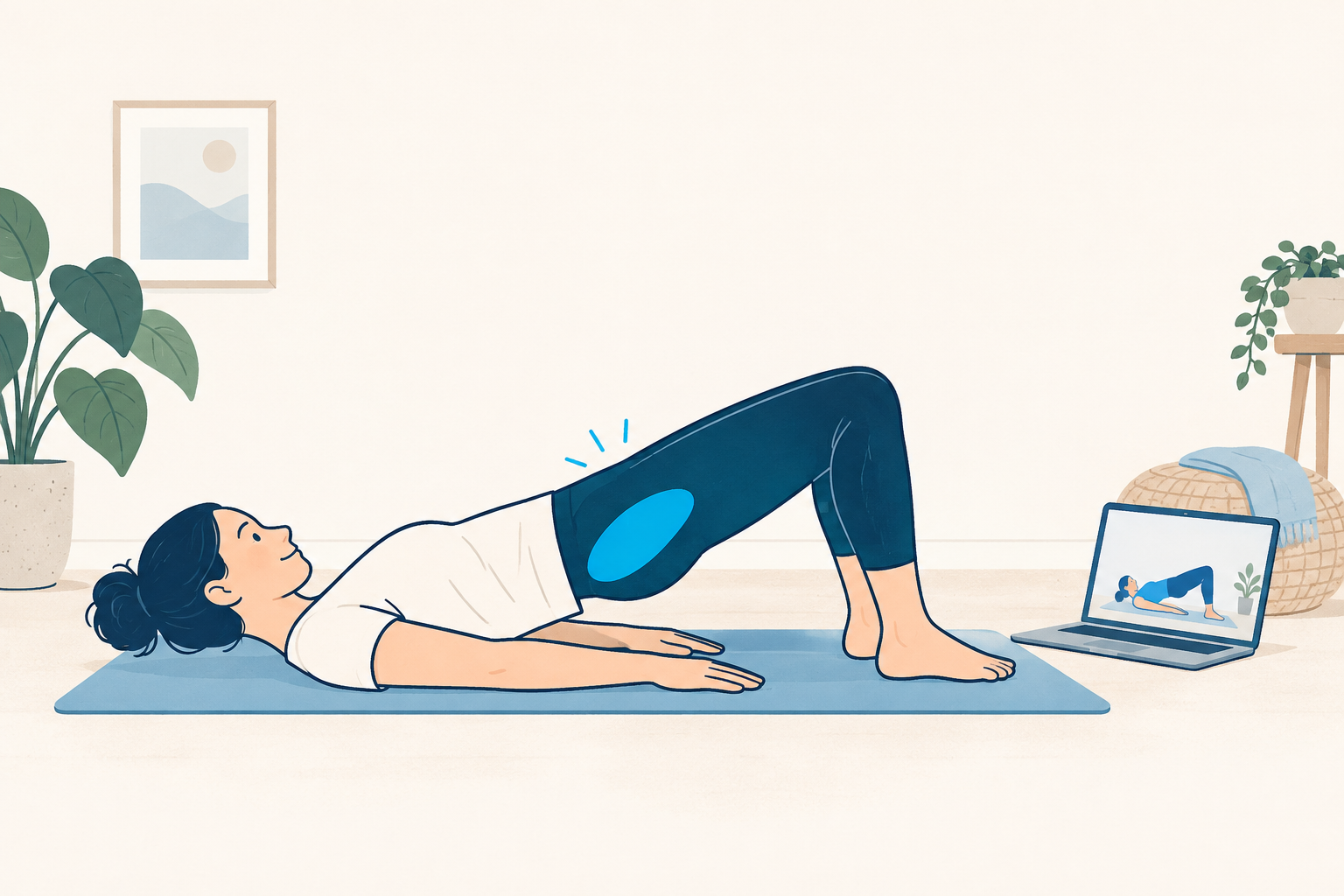
PhysioOnClick builds every home exercise programme around video consultations, so a physiotherapist can watch technique and adjust the plan remotely rather than relying on a printed sheet alone. The exercises that work best are rarely the most complicated ones — they're the ones a person can actually do consistently. Home exercise programmes fail more often from poor adherence and unclear dosage than from choosing the 'wrong' exercise, which is why physiotherapy puts as much emphasis on habit-building and progression rules as on the movements themselves.
A well-designed home programme specifies not just which exercises, but how much (sets, reps, load), how often, and clear criteria for when to progress, hold, or scale back — removing the guesswork that causes people to either under-do it or overdo it on a good day.
Practical guidance on hip and knee strength
Hip strength — particularly the muscles that control the pelvis from side to side and rotation of the thigh — has a disproportionate influence on knee symptoms, because weakness here often shows up as poor control at the knee during single-leg tasks like stairs, running or landing from a jump, even when the knee itself has no structural problem.
A hip-and-knee strengthening programme typically progresses from double-leg to single-leg exercises, and from controlled, slow movements to more dynamic ones (step-downs, single-leg squats, eventually hopping where relevant), matching the demands of whatever activity someone is trying to return to.
What physiotherapy assessment looks at
Before prescribing a home programme, a physiotherapist checks baseline strength and movement quality, current activity levels, equipment and space available at home, and any specific goals so the plan is realistic rather than generic.
Where hip and knee strength is the main day-to-day problem, assessment also looks specifically at how that symptom behaves — what makes it better or worse, and how it's changed since it started — since that shapes which part of the rehab plan gets priority first.
A practical starting point
Add a simple single-leg exercise — a slow step-down onto a low step, controlled for 3 seconds on the way down — two to three times a week, watching in a mirror or filming yourself to check the knee isn't collapsing inward as a sign of poor hip control.
This guide is part of PhysioOnClick's patient education library and is intended to support informed decisions, not replace an individual assessment. If symptoms are worsening, unclear, or affecting your confidence with movement, a full physiotherapy assessment is the safest next step.
When to seek extra help
Sharp new pain during an exercise that doesn't ease with rest, exercises that consistently worsen symptoms the following day, or new neurological symptoms (numbness, weakness) starting during a home programme should prompt a pause and a physiotherapy review, not pushing through. Sudden weakness or numbness down one side of the body, a drooping face or trouble speaking is different: call 999 (possible stroke), and do not drive yourself.