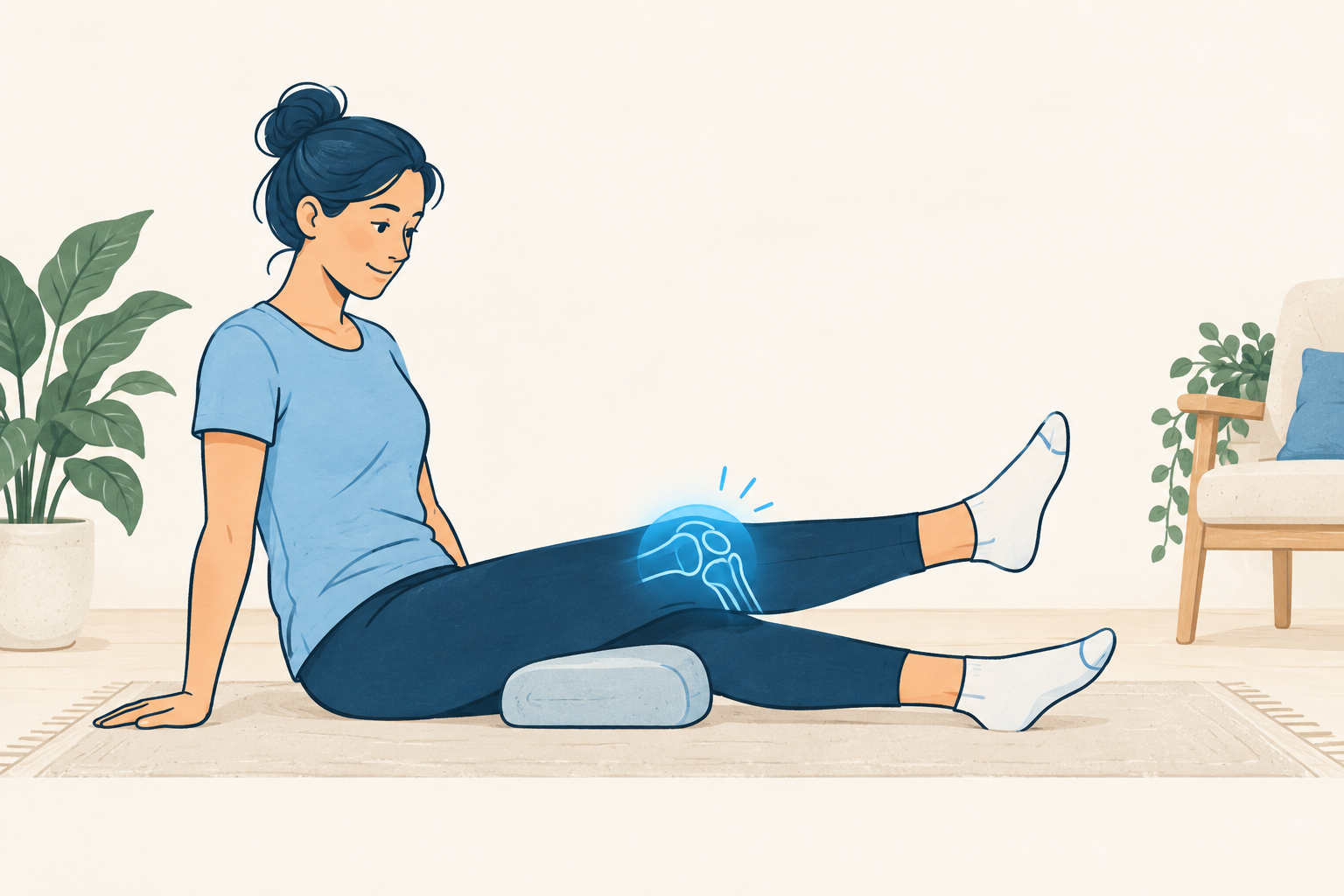
What's going on
Knee assessments at PhysioOnClick happen by video, or as a home visit in the Glasgow area, and the reasoning below is exactly what a physiotherapist looks for in either setting. Knee symptoms usually trace back to one of three patterns: a specific traumatic injury (ligament, meniscus or patellar), an overuse presentation from a sudden change in load (runner's knee, patellar tendinopathy), or degenerative change where cartilage and joint surfaces have gradually lost tolerance to load. Each responds to a different rehab emphasis, which is why a generic 'knee exercise' plan often underperforms.
Swelling, locking, giving way and a clear mechanism of injury point toward a structural cause worth imaging; a gradual ache that builds with specific activities and settles with rest points more toward a load-tolerance problem that usually responds to a structured strengthening programme rather than scans.
Practical guidance on exercise pacing
The 'boom and bust' cycle — pushing hard on a good day and then needing several days to recover — is one of the most common barriers to steady progress. Pacing means choosing an activity level that's sustainable most days, even on better days, and increasing it gradually on a planned schedule rather than in response to how you feel that morning.
A structured approach sets a baseline slightly below what currently causes a flare-up, holds it consistently for one to two weeks, and only then increases by a small, predictable amount — usually 10–20%. This trades short-term temptation for a more predictable, faster overall recovery.
What physiotherapy assessment looks at
Assessment looks at how the knee was injured (or whether it built up gradually), joint line tenderness, ligament stability tests, quadriceps and hip strength, and functional tasks like a single-leg squat or step-down to see how the whole limb shares load, not just the joint itself.
Where exercise pacing is the main day-to-day problem, assessment also looks specifically at how that symptom behaves — what makes it better or worse, and how it's changed since it started — since that shapes which part of the rehab plan gets priority first.
A practical starting point
Write down your current baseline for one key activity (minutes walking, reps of an exercise, hours at a desk before a break) and commit to that exact amount for two weeks before increasing it, regardless of how good a particular day feels.
This guide is part of PhysioOnClick's patient education library and is intended to support informed decisions, not replace an individual assessment. If symptoms are worsening, unclear, or affecting your confidence with movement, a full physiotherapy assessment is the safest next step.
When to seek extra help
A knee that is hot, red and swollen with a fever needs A&E now, or a call to NHS 111 straight away if you are not sure where to go, to rule out a joint infection. A knee that is significantly swollen within hours of injury, locked in a fixed position, or unable to bear any weight at all needs same-day medical assessment (NHS 111 or an urgent treatment centre) to rule out a fracture or complete ligament rupture before starting rehabilitation.